Why Your Puppy Bites Everything ,And What You Can Actually Do About It
Let me guess. You brought home this tiny, ridiculous ball of fluff, fully prepared to fall in love and you did. Immediately. Completely. But somewhere between Day 1 and Day 4, you also noticed that this adorable creature has the jaw strength of something twice its size, and absolutely zero interest in keeping it to itself.

Your fingers. Your toes. The corner of your laptop charger. Your favourite chappal that you’ve owned for six years. The cushion you just bought. Your actual hand while you were trying to pet them.
Nothing is safe. Nothing.
If this is your life right now, I want you to know two things. First you are not alone. Not even a little bit. Every single person who has ever raised a puppy has sat exactly where you’re sitting, probably nursing a fresh set of tiny tooth marks. Second this is not your puppy being bad. This is your puppy being a puppy. And there’s a world of difference between the two.
Your Puppy Isn’t Aggressive. They’re Just… a Puppy.
This is the part that trips up so many new pet parents. The biting feels intense. It feels personal. Sometimes it genuinely hurts. And so the brain goes: is my puppy aggressive? Did I get a difficult dog? Is something wrong?
Almost certainly, the answer is no.
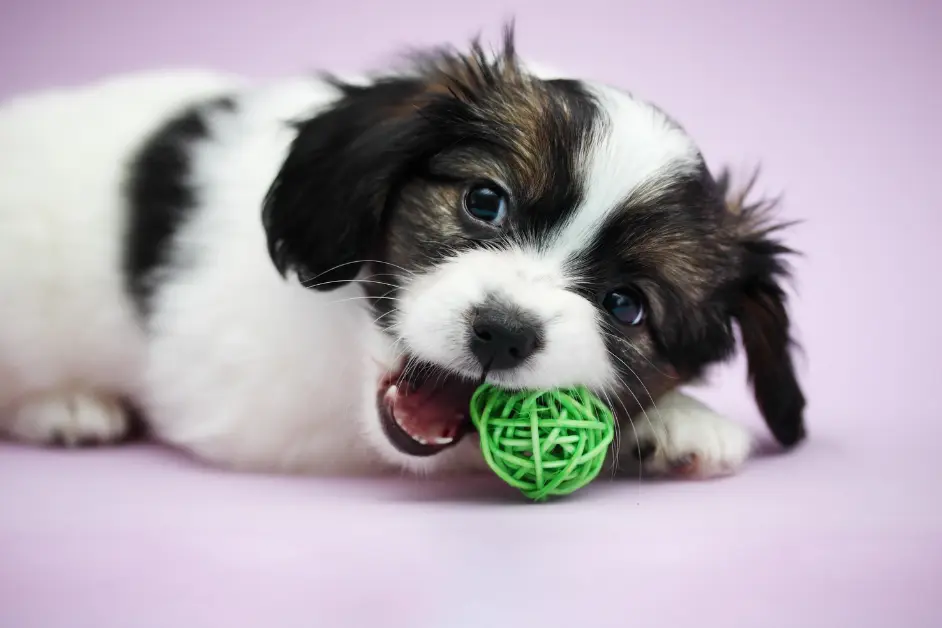
Puppies bite because their mouths are essentially their hands. They have no other way to pick things up, investigate textures, or interact with the world around them. When your puppy bites your fingers, they’re not attacking you they’re curious about you. They’re exploring. That same instinct that makes a human baby put everything in their mouth? It’s the same thing, just with sharper equipment.
There’s also the teething factor, which doesn’t get talked about enough. Between roughly three and six months of age, your puppy’s baby teeth are falling out and adult teeth are pushing through. That process is genuinely uncomfortable — sometimes painful. Chewing and biting bring relief, in the same way that a teething ring soothes a baby’s gums. During this phase, the biting often gets more intense before it gets better. That’s not your puppy getting worse. That’s your puppy being in discomfort and doing the only thing that helps.
And then there’s play. In the litter, puppies play by biting each other. That’s just how they do it. It’s how they bond, how they communicate, how they burn energy. When your puppy chomps on your ankle while you’re walking to the kitchen, they think this is a completely normal and fun game. Because for them, it always was until now.
The One Thing Most People Get Wrong About Puppy Biting
Here’s something that surprises a lot of people: the goal early on isn’t to stop your puppy from biting altogether. It’s to teach them how to bite or more specifically, how gently.
This is called bite inhibition, and it’s one of the most important things a puppy can learn. A dog with good bite inhibition has an internal gauge they know how much pressure is too much. A dog without it doesn’t have that gauge, which means even accidental contact can cause real injury.
In the litter, puppies teach each other this naturally. You bite too hard, the other puppy yelps and the game stops. Cause and effect, repeated dozens of times a day. That’s how the lesson gets learned.
When puppies leave their litter especially if they leave before eight weeks, which unfortunately happens more often than it should in India they miss some of that crucial feedback time. And that means you have to step in and provide it.
The reason this matters is that going straight from “puppy who bites everything” to “puppy who never mouths at all” often backfires. You end up with a dog who hasn’t developed bite inhibition, which is actually more dangerous in the long run than a dog who went through a proper, gradual process of learning. So don’t panic about every little nip. Focus first on reducing the force, then on reducing the frequency.
What Actually Works And What Doesn’t
Let’s start with what doesn’t work, because a lot of well-meaning advice floating around will actually make things worse.
Tapping your puppy on the nose. Holding their mouth shut. Flipping them on their back. These are old-school techniques that don’t teach your puppy anything useful they just create confusion and, over time, erode trust. A puppy who’s afraid of you is not a puppy who’s learning. They’re a puppy who’s shutting down. Now, what actually works.
Yelp and stop. When your puppy bites too hard, make a sharp, high-pitched sound the kind a hurt puppy would make and immediately go completely still and ignore them for about 15 to 20 seconds. No eye contact, no talking, no pushing them away. Just nothing.
This lands because it speaks their language. In the litter, a too-hard bite made the other puppy yelp and stop playing. Game over. Your puppy understands this feedback instinctively, far better than any human scolding.
The catch is that everyone in your household has to do this consistently. If you do it every time but your partner thinks it’s funny and lets the puppy chew on them, your puppy is getting mixed signals and mixed signals mean slow progress.
Redirect immediately. Keep chew toys within arm’s reach everywhere in your home. The moment your puppy goes for your hand, swap in a toy without a fuss. Not after a few seconds. Not once you’ve managed to get them off. Immediately. The faster the swap, the clearer the message: this is what mouths are for. Hands are not.
For teething puppies especially, chilled rubber toys or a frozen carrot can work wonders. The cold soothes sore gums, and suddenly that toy is way more interesting than your fingers.
The time-out. If the biting continues despite redirection if your puppy is too wound up to even register what you’re doing a short, calm time-out works well. Put them in their crate or a quiet room for one or two minutes. No drama, no raised voice, just a matter-of-fact removal from the situation.
Puppies are social animals. Being separated from their person, even briefly, is genuinely unpleasant for them. They make the connection quickly.
Wear them out. A tired puppy bites considerably less than a bored, restless one. Make sure your puppy is getting age-appropriate exercise short, gentle sessions for young pups since their joints are still developing plus mental stimulation through training games and puzzle toys. Puppies need between 16 and 18 hours of sleep a day, and an overtired puppy who hasn’t napped is going to be an absolute menace. Build nap time into the daily routine.
Start basic training early. Teaching your puppy “sit,” “leave it,” and “off” gives you real tools to interrupt biting moments before they escalate. Five-minute training sessions using treats and praise tire puppies out mentally, burn off restless energy, and start building the communication between you that makes everything else easier.
Some Breeds Are Just Mouthier And That’s Okay
If you have a Labrador, a Golden Retriever, a Cocker Spaniel, or a herding breed like a Border Collie, you may have noticed that the biting seems particularly enthusiastic. That’s not a coincidence.
Labs and Goldens were literally bred to carry things in their mouths it’s deeply wired into them. Herding breeds have an instinct to nip at heels from centuries of working with livestock. Terriers are tenacious by nature. None of this means training won’t work. It absolutely will. It just means you need to be a little more patient, a little more consistent, and a little less surprised when the process takes longer than it did for your neighbour’s Shih Tzu.
When Should You Actually Be Worried?
The vast majority of puppy biting is completely normal and responds to consistent training within a few weeks to a few months. But there are some signs that are worth taking more seriously.
If your puppy growls, snaps, or goes stiff and rigid before or during a bite — especially over food, toys, or certain spaces — that’s not play biting. That’s a dog communicating discomfort or guarding something, and it needs to be addressed with professional guidance rather than DIY training alone.
If the biting isn’t improving at all despite weeks of consistent effort, or if your puppy is over six months old and still biting with real force, it’s worth bringing in a certified dog trainer. Not because something is terribly wrong, but because a professional eye can often spot what’s being missed and give you a much faster path forward.
A Rough Timeline So You Know What to Expect
Eight to ten weeks in, constant mouthing is just the baseline it’s entirely normal and it will feel relentless. From ten weeks to about four months, teething kicks in and things may actually intensify before they improve. Between three and five months of consistent, patient training, you should start seeing real progress bites getting gentler, redirections working more quickly. By five to seven months, adult teeth are in, teething is over, and biting should be largely under control. If you’re past six months with no improvement, that’s when to call in a trainer.
It Gets Better. It Really Does.
I know that when you’re on your third bandage of the week and your puppy is eyeing your shoelace with what can only be described as predatory intent, “it gets better” can feel like hollow reassurance.
But it does. Every single person who has raised a puppy through this phase and come out the other side with a gentle, calm adult dog will tell you the same thing. The window where puppies bite everything is actually quite short, even though it doesn’t feel that way when you’re living inside it.
Stay consistent. Stay calm. Don’t take it personally. Your puppy isn’t trying to make you miserable they’re just figuring out the world, and right now, their mouth is their favourite tool for doing that.
Give it time. Give it consistency. And give yourself a little grace too because raising a puppy is genuinely hard work, and you’re doing better than you think. At Yes Paws, we’re cheering for both of you. Have a puppy biting question we didn’t cover? Drop it in the comments below we’d love to help.

yespaws
Recent Posts
-
 How to Manage Pets in Small Apartments September 12, 2026
 -
 Indoor Games to Keep Pets Active September 11, 2026
 -
 How Much Exercise Does Your Dog Really Need September 10, 2026
 -
 First-Time Cat Owner? Here’s How to Groom Your Cat Safely September 9, 2026
 -
 Safety Tips for Night Walks with Dogs September 8, 2026